
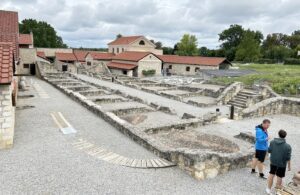
 Some Roman sites impress you with scale. Others with atmosphere. Carnuntum, just outside Vienna, does both—and then goes one step further. This former Roman powerhouse on the Danube is not just an archaeological site but a fully walkable Roman city quarter, reconstructed directly on its ancient foundations. It is one of the very few places in Europe where you can move through Roman streets, houses, and baths as complete spaces rather than fragments. My own story with Carnuntum began years ago on a secondary school excursion with our Latin teacher. Back then, it was a landscape of foundations and imagination. Returning as an adult, I was genuinely taken aback by how convincingly the Roman city of Carnuntum has been brought back to life. What was once abstract is now tangible, immersive, and deeply memorable.
For visitors looking beyond the obvious sights, Carnuntum is one of the most rewarding Roman ruins near Vienna and an outstanding day trip from Vienna.
What Was Carnuntum?
 Carnuntum was one of the most important Roman cities north of the Alps. At its height, this ancient Roman city in Austria was home to an estimated 50,000 inhabitants and served as a key military, administrative, and commercial hub of the Roman Empire. Strategically positioned on the Danube Limes, Carnuntum combined a legionary fortress with a large civilian settlement. Emperors passed through the city, legions were stationed nearby, and long-distance trade flourished along Roman roads and the river. Marcus Aurelius is known to have spent time here, and in AD 193 Septimius Severus was proclaimed emperor in Carnuntum by his troops.
Over time, political instability and natural disasters led to the city’s decline. Carnuntum was eventually abandoned, its buildings collapsing and disappearing beneath the soil—until archaeology began to uncover its former significance.
Where Is Carnuntum?
One of Carnuntum’s great strengths is its accessibility. Located around 40 kilometres east of Vienna, it is one of the easiest and most impressive Roman ruins near Vienna to visit. This makes Carnuntum a straightforward half-day or full-day day trip from Vienna, whether you are based in the city or exploring Lower Austria.
What to See at the Carnuntum Archaeological Park
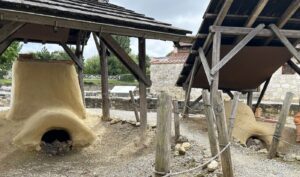 The heart of the site is the Carnuntum Archaeological Park, where archaeology and reconstruction come together in a way that is unique worldwide. Unlike most Roman sites, Carnuntum does not rely solely on preserved ruins. Instead, an entire Roman city quarter has been carefully reconstructed directly on the original foundations, using archaeological evidence, experimental archaeology, and ancient Roman building techniques. Walking through the park today feels less like visiting a museum and more like entering a Roman neighbourhood that has momentarily paused in time.
From School Trip to Living Roman City
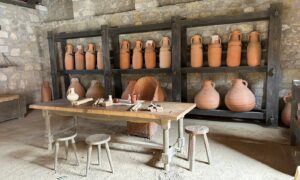 My first visit to Carnuntum was a typical school excursion. Our Latin teacher guided us across stone foundations, encouraging us to imagine temples, houses, and streets that no longer visibly existed. It was intellectually interesting, but abstract. Returning years later was a completely different experience. Roofs had risen where I once saw only low walls. Streets, rooms, heating systems, and furnishings had been reconstructed with extraordinary care. For the first time, the Roman city of Carnuntum felt tangible and human.
This transformation is what makes Carnuntum so exceptional. The reconstructions are not decorative replicas but scholarly interpretations built at full scale, allowing visitors to understand Roman urban life through physical experience.
Life in Roman Carnuntum
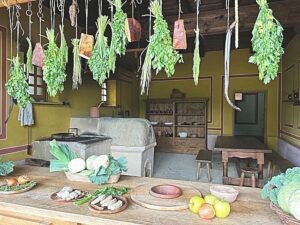 The reconstructed city quarter reveals how Romans actually lived. Domestic spaces, workshops, and public buildings show how everyday life unfolded in this important provincial city. Underfloor heating systems demonstrate Roman engineering ingenuity. Kitchens, storage rooms, and living spaces reveal social hierarchy and household organisation. Business and private life often overlapped, especially in houses that combined residential and commercial functions. For anyone who studied Latin or Roman history at school, Carnuntum provides those rare moments when textbook knowledge suddenly becomes real.
Emperor Marcus Aurelius in Carnuntum
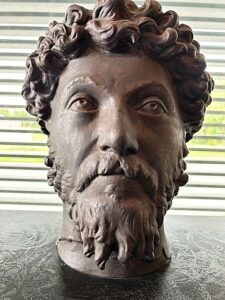 Carnuntum is also closely associated with Emperor Marcus Aurelius, the philosopher-emperor best known for his work Meditations. During the Marcomannic Wars in the late 2nd century AD, Marcus Aurelius spent extended periods on the Danube frontier, and historical sources indicate that he resided in Carnuntum while commanding Roman forces. It is widely believed that parts of Meditations were written here, in the challenging conditions of a military campaign far from Rome. Standing in Carnuntum today—on what was once the edge of the Roman world—it is easy to imagine the emperor reflecting on duty, mortality, and self-discipline amid the realities of frontier life. This connection adds a powerful intellectual and human dimension to the Roman city and underlines its importance within the empire.
The House of Lucius: A Roman Home and Business
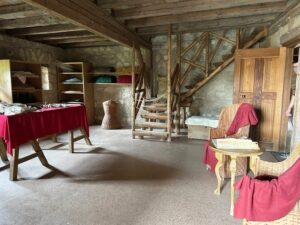 One of the most memorable buildings in the Archaeological Park is the House of Lucius, an expansive and clearly affluent Roman townhouse. A welcomes visitors and once served as a shaded area for social interaction. Inside, the house unfolds through a sequence of rooms that illustrate both domestic comfort and economic activity. Highlights include:
- A huge weaving frame, showing the importance of textile production
- A light-filled south-facing veranda
- A fully equipped Roman kitchen
- Comfortable living and dining rooms
- A combined show and sales room (see photo), where goods were presented to customers
Walking through the House of Lucius feels remarkably intimate. These spaces were not designed to impress modern visitors, yet they convey a vivid sense of daily Roman life.
The Roman Public Baths of Carnuntum
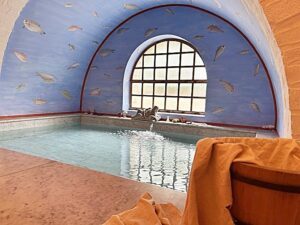 Public baths were the social heart of every Roman city, and Carnuntum’s baths are among the most impressive north of the Alps. At their centre lies the basilica thermarum, a large and elegant assembly hall that functioned as the main meeting space. Even today, the scale of the room conveys its former importance within the city. From here, bathers progressed through the traditional sequence of bathing rooms:
- Hot water pools in the caldarium
- Warm transitional spaces
- Cold water pools in the frigidarium (see photo)
Seeing the bathing complex reconstructed makes Roman engineering brilliance tangible, from the heating systems to the careful control of temperature and movement.
Is Carnuntum Worth Visiting?
 Without hesitation: yes. Carnuntum is not simply an archaeological site but a benchmark for how Roman history can be presented to the public. Before you even step into the reconstructed city, the entrance building exhibition sets the scene beautifully. Clear displays, maps, and short videos of Roman life in Carnuntum explain what Carnuntum was, how the city developed, and why the reconstructions matter. This framework makes the outdoor visit far more rewarding, as you already understand the city’s layout, function, and historical importance when you walk its streets. The combination of original remains, full-scale reconstructions, and clear interpretation makes it one of the most rewarding Roman ruins near Vienna and a highlight for anyone interested in antiquity.
Museum Carnuntinum: Understanding Roman Carnuntum
While the Archaeological Park brings the Roman city to life, the Museum Carnuntinum provides the historical and archaeological context that completes the experience. Housed in an elegant early 20th-century building, the museum displays original finds from Carnuntum and explains how archaeologists have reconstructed the city’s story.
What You’ll See at the Museum Carnuntinum
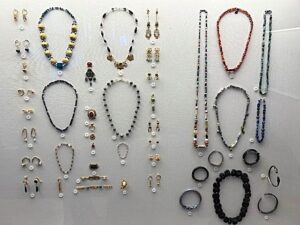 The museum’s collection includes:
- Sculptures and architectural fragments from temples and public buildings
- Inscriptions revealing military, political, and private life
- Jewellery, tools, and everyday household objects
- Detailed models illustrating Carnuntum’s development over time
After walking through the reconstructed Roman city, these artefacts feel immediately familiar, grounding the reconstructions in authentic material culture.
Archaeology, Reconstruction, and Interpretation
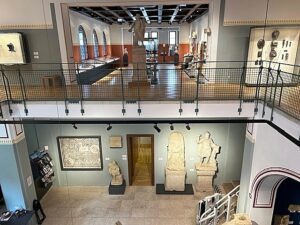 One of the museum’s strengths is its transparency. Exhibits explain how archaeologists identified foundations, interpreted evidence, and justified reconstructions. This insight deepens appreciation for the Archaeological Park. Every wall, roof, and room outside is clearly the result of rigorous research rather than creative guesswork. For me, this contrast to my early school visit was striking. What once felt theoretical is now coherent, logical, and convincingly real.
Carnuntum with Children and Curious Minds
Together, the Archaeological Park and the Museum Carnuntinum make Carnuntum an excellent destination for families, school groups, and lifelong learners. The combination of open-air exploration and indoor explanation ensures that Carnuntum appeals both emotionally and intellectually. If you are short on time consider visiting the Roman museum in Vienna, though it is naturally only capable of offering a fraction of the experience that the much larger archeological park in Carnuntum does.
Final Thoughts: A Living Roman City Near Vienna
Carnuntum has grown from scattered archaeological remains into one of Europe’s most immersive Roman experiences. The reconstructed city quarter—built directly on ancient foundations and grounded in rigorous research—is globally unique.
Walking through the House of Lucius, standing in the basilica thermarum, or following the route from hot to cold pools in the public baths offers something rare: a real sense of how a Roman city once functioned.
If you enjoy discovering lesser-known places, exploring ancient history near Vienna, or adding depth to a Vienna itinerary, Carnuntum is not just worth visiting—it is unforgettable.
Practical Information for Visiting Carnuntum
How to Get to Carnuntum from Vienna
Carnuntum is located around 40 kilometres east of Vienna, making it an easy and rewarding day trip.
By train
Take a regional train from Vienna’s Wien Mitte-Landstraße station to Petronell-Carnuntum. The train ride takes about 45 to 50 minutes. From the station, the Archaeological Park and Museum Carnuntinum are within walking distance. This is the easiest option if you are visiting without a car.
By car
From Vienna, follow the A4 motorway towards Bratislava and take the exit for Petronell-Carnuntum. Parking is available near the archaeological sites. If you rent a car consider visiting nearby baroque castle Schlosshof. Both sites can easily be done in one day trip from Vienna.
By bike
Carnuntum can also be reached via the Danube Cycle Path, making it a popular stop for cyclists exploring the Vienna–Bratislava route.
Opening Times
Opening times at Carnuntum vary depending on the season and the specific site (Archaeological Park or Museum Carnuntinum).
- The Archaeological Park Carnuntum generally operates with extended hours in spring and summer
- The Museum Carnuntinum has shorter winter opening hours
As opening times can change, especially outside peak season, it is best to check the official Carnuntum website shortly before your visit for current hours and ticket information.
How Long Do You Need to Visit Carnuntum?
To do Carnuntum justice, plan for at least half a day.
- 2–3 hours allows time to walk through the reconstructed Roman city quarter and public baths
- 3–4 hours is ideal if you also want to visit the Museum Carnuntinum at a relaxed pace
If you enjoy archaeology, photography, or slow travel, a full day at Carnuntum is easily filled.
Tickets and Admission
Tickets for Carnuntum are available for individual sites or as combined tickets covering both the Archaeological Park and the Museum Carnuntinum.
Prices may vary by season, special exhibitions, or events, so it is advisable to check the official Carnuntum website for up-to-date admission fees and any discounts for families, children, or groups.
Carnuntum FAQs (Planning Your Visit)
These questions come up again and again when planning a visit to Carnuntum—and for good reason.
Is Carnuntum worth visiting?
Yes. Carnuntum is one of the most immersive Roman sites in Europe and among the best Roman ruins near Vienna. The full-scale reconstructions built directly on ancient foundations make it a unique experience.
Is Carnuntum suitable for children?
Absolutely. The open-air layout, reconstructed buildings, and spacious grounds make Carnuntum engaging for children, especially when combined with the explanatory exhibits in the Museum Carnuntinum.
Can you visit Carnuntum as a day trip from Vienna?
Yes. Thanks to its proximity and good transport connections, Carnuntum is an easy and rewarding day trip from Vienna, whether by train, car, or bicycle.
Is Carnuntum accessible without a car?
Yes. Trains from Vienna stop at Petronell-Carnuntum, from where both the Archaeological Park and Museum Carnuntinum can be reached on foot.


